
Everybody has seen the iconic photos. Jagged limestone spires in the Italian Alps, a green meadow, maybe one small figure on the trail for scale. What you don’t see is everyone else standing just outside the frame, because I cropped them out too. Building a Dolomites itinerary that gets you those views without the crowds takes more planning than any trip Chris and I have taken in Europe. The Dolomites sit in the far north of Italy, part of the Italian Alps, close enough to Austria that every town, mountain, and trail carries an Italian name and a German one.
In August 2026, Chris and I spent twelve days in the Dolomites, based in three different valleys, and I am going to tell you exactly how it went. On day three we rode the most expensive gondola of the trip up to Seceda and got about twenty rain-free minutes on the ridge before it started to pour. We turned back when the trail into the national park became pure mud. On day ten I crossed five improvised footholds where a rockslide had eaten the narrow mountain trail at Tre Cime, saying a prayer every step of the way. Both of those days made this itinerary better, and you won’t find either experience in the glossy online versions.
Why the Dolomites Are Worth the Trip
This page may contain affiliate links. If you choose to click on one of the links and then make a purchase, Just Wander More may earn a small commission. The commission is paid by the company at no extra expense to you. Read the full disclosure here.
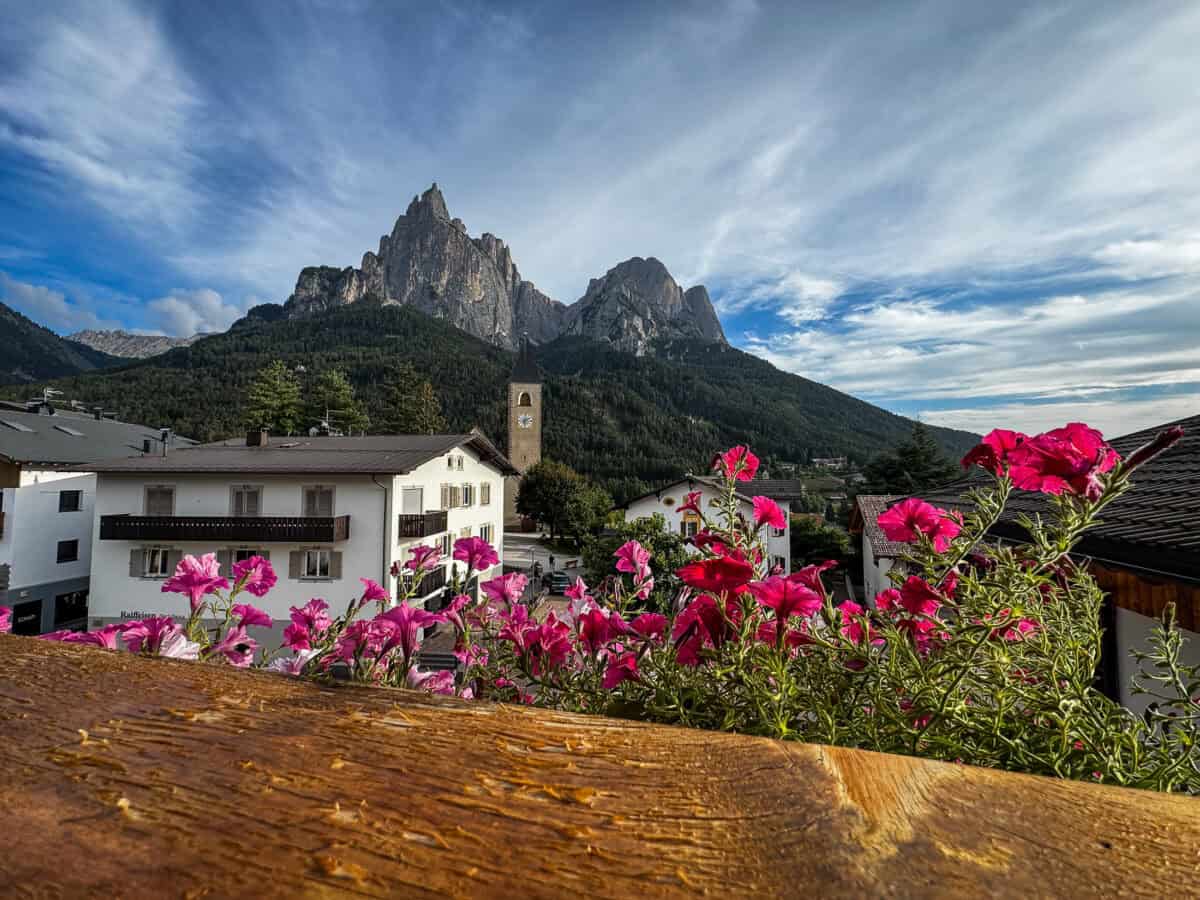
The Dolomites are not the Alps you might be picturing. Instead of snow caps and glaciers, you get pale jagged limestone peaks that tower over green meadows. It is a range built for people who like looking at mountains as much as climbing them, and if you are planning a trip to Italy expecting Tuscany or the Amalfi Coast, this corner will surprise you.
What surprised me was the scale of the flat parts. Alpe di Siusi is the largest alpine meadow in Europe and it took Chris and me eight miles to loop the edge of it. Someone mows the whole thing. And you are never far from a rifugio, the mountainside huts that serve real meals, so you can hike all day without carrying much beyond water.
In twelve days across three valleys, we never saw a single fast food restaurant. That tells you most of what you need to know about the uniqueness of the Dolomites, and it’s one of the things I love about travel in Europe.
Where the Dolomites Are
The Dolomites sit in the far northeast corner of Italy, tucked up against the Austrian border. They are a mountain range rather than a destination. There is no town called Dolomites. What you are actually choosing between is a set of valleys, each with its own character and its own base towns. The valley you pick when planning a trip to Italy shapes your entire trip more than any single sight does.
The Dolomites are part of the Italian Alps, though that phrase covers a lot of ground. If you have been reading about Courmayeur or the Matterhorn, that is the western part of Italy. The Dolomites are the opposite corner, and they look nothing alike. Pale limestone instead of granite and glaciers, which is why they were given their own UNESCO World Heritage listing in 2009.
Why Every Place Has Two Names & Some Have Three

The thing nobody warns you about is the names. This region belonged to Austria until the end of the First World War; the German influence remains today. You will find that South Tyrol has three official languages, so most signs, mountains, towns, and hikes carry an Italian name and a German one, and in valleys such as Val Gardena, a third name in Ladin (the local language). Your hotel booking, your gondola ticket, and the road sign pointing you there may all say different words for the same place.
| You’ll See in Italian | You’ll Also see in German (& Ladin) | What It Actually Is |
|---|---|---|
| Ortisei | St. Ulrich, Urtijëi | A town in Val Gardena. |
| Alpe di Siusi | Seiser Alm | The mountain plateau, not a town, within the Sciliar-Catinaccio Nature Park. Surrounding peaks are Sciliar (Schlern), Sassolungo (Langkofel), Sassopiatto (Plattkofel), and Catinaccio (Rosengarten). |
| Castelrotto | Kastelruth | A municipality covering several villages, including Siusi. |
| Siusi | Seis | Village with the Alpe di Siusi lift in the Castelrotto municipality. |
| Val Gardena | Gröden, Gherdëina | A valley containing three separate municipalities: Ortisei, Santa Cristina Valgardena, and Selva di Val Gardena. |
| Tre Cime di Lavaredo | Drei Zinnen | “Three Peaks” or limestone towers with a loop trail around them, in the far eastern Dolomites. |
Closest Dolomites Airports
You will not find a major airport in the Dolomites. There is a small one at Bolzano, but service is limited and seasonal, so in practice everyone flies into a city a few hours away and drives in. Which one you pick matters less than you’d think, because all the realistic options land within about four hours or less from Val Gardena. (Drive times are approximate and assume the passes are open.)
- Innsbruck, about 2 hours, the closest but with the fewest long-haul options.
- Verona, about 2.5 hours, useful if you’re connecting within Italy.
- Venice Marco Polo, about 3 hours, the easiest to pair with a stopover.
- Munich, about 4 hours, the best long-haul connections and the prettiest drive in.
- Bolzano, about 45 minutes, tiny and seasonal so rarely the answer.
One thing to weigh before you book. Venice and Verona keep you in Italy the whole way, so you pay Italian tolls and nothing else. Munich and Innsbruck both cross Austria, which adds a motorway vignette and a separate toll at the Brenner Pass. Neither is expensive, but it’s more to sort out, and the costs are broken down below.
Chris and I flew Denver to Dulles to Munich and drove to Italy from there. Award availability picked the route, but Chris also checked EES wait times in advance and Munich was reporting some of the shortest, which mattered more than we expected.
Check EES wait times before you book. Non-EU travelers now go through EES processing at Immigration, where they scan your passport, take your photo, and collect your fingerprints before you reach the passport desk. Wait times vary a lot between airports and the system is new enough that they are still settling. We came off the plane moving fast to get ahead of the queue. If you have a tight connection, build in more time than you think you need.

Getting from the Airports to the Dolomites
You’ve landed. Now you have a three or four-hour drive ahead of you driving to the Dolomites and, depending on your route, three separate things to pay for along the way. None of it is complicated, but it catches people who assumed one toll covered the trip. So, here’s what to sort out before you’re standing at the rental counter. All things to consider when determining which airport might be the best for you.
Renting a Car
You will also need a rental car, and you’ll need to book it in advance. There is no version of this trip that works without one. We picked ours up at Munich from Hertz and got a Mercedes that Chris has described ever since as “gutless,” which turned out to matter on the Dolomite passes. Budget for the cross-border fee too, since most companies charge one when you drive a car registered in one country into another. Ours came to €35 plus taxes, approximately $65 USD at the time.
The Austria Vignette & Tolls
Flying into Munich also means crossing Austria, which requires a vignette on its motorways. You only need coverage on the days you’re actually driving there, so work out which days you’ll be crossing rather than how long you’ll be gone.
A ten-day vignette runs €11.50 and looks like the obvious choice until you check your dates. Ours were twelve days apart, so a ten-day would have covered the drive down and expired before the drive back, leaving us buying a second one anyway. Chris bought two single-days for about €20 total and they covered exactly the days we needed. If your crossings fall within ten days of each other, take the ten-day instead.
Buy online, but know the digital vignette is tied to your license plate, and you won’t have that until you’re standing at the rental counter. Buy right after pickup and waive the cooling-off period so it’s valid immediately. Austria checks by camera and the penalty runs well over €100, so it isn’t worth gambling to save ten euros.
The Brenner Pass charges its own toll of €11.50 each way at the booth, and a vignette does not cover it. Italy’s A22 is then tolled by distance on top of that.
What the Drive In Actually Costs
Driving in from Munich, before fuel and parking:
- Two single-day Austrian vignettes, about €20
- Brenner Pass toll, €11.50 each way
- Cross-border rental fee, €35 plus tax
- Italian A22 tolls, charged by distance
Driving in the Dolomites
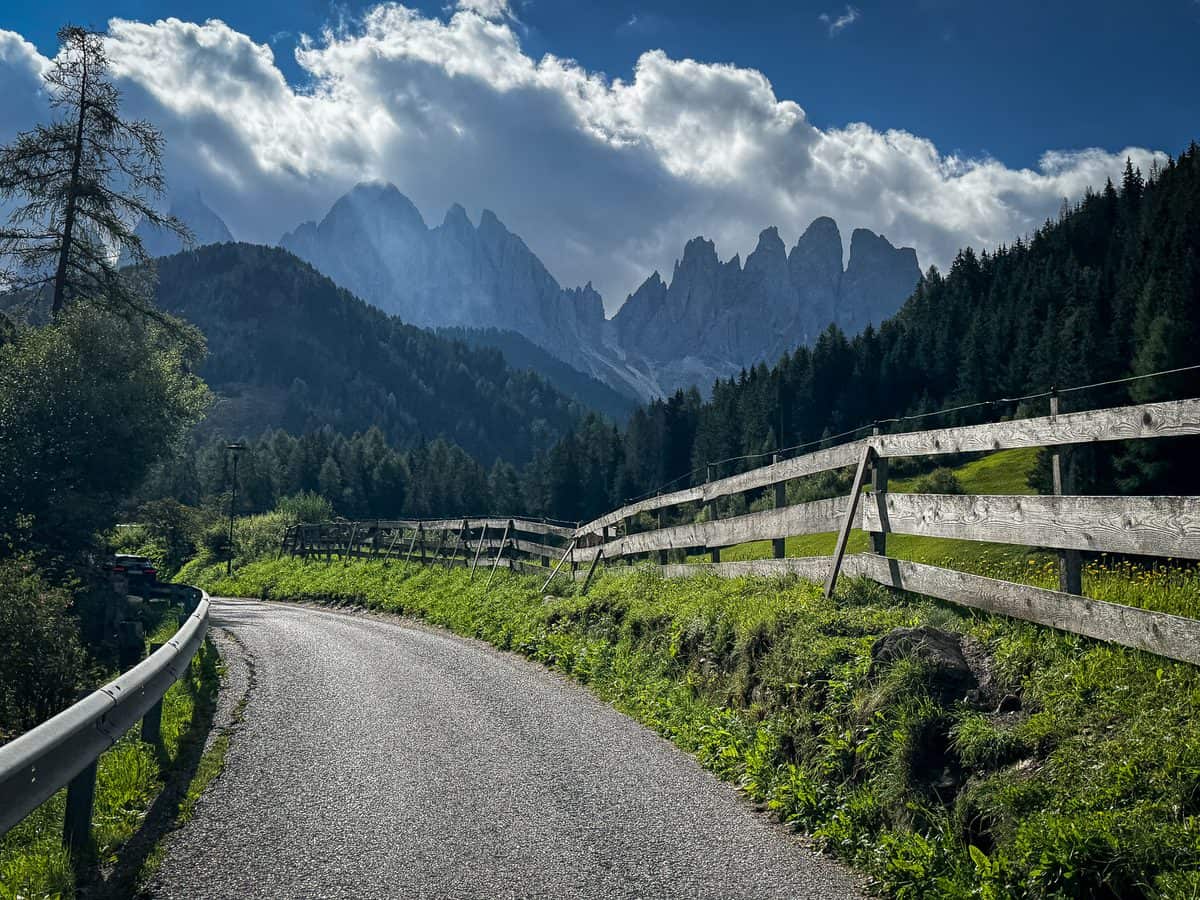
Driving in the Dolomites isn’t how you get from one good part to the next. It is one of the good parts. The passes connecting the valleys are the reason people ship their motorcycles in and and it is one of the feature climbs of the Giro d’Italia, Italy’s answer to the Tour de France. The passes are narrower, steeper, and busier than you might be expecting.
The Passes
Passo Giau is the one that will stay with you. Twenty-nine hairpin turns—tornanti—and they are numbered, with a sign at the bottom telling you exactly how many are coming. The climb is a nonstop 9% average incline linking the Ampezzo and Livinallongo valleys, and it is one of the feature roads of the Giro d’Italia. Whatever you rent will feel underpowered on a sustained 9% grade, especially loaded with luggage. If you have the option, size up a class from what you’d normally book.
You will share every pass with cyclists, and they are not casual riders. Give them room, expect to sit behind them on blind corners, and pass with care.
Narrow Roads & Pullouts

Away from the main passes, plenty of roads are a single lane doing the work of two. You watch for oncoming traffic, and whoever reaches a pullout first tucks in and waits. It works fine once you understand the etiquette, but it is not relaxing.
We turned around on one climb above Val di Funes when the road got tighter than we wanted to deal with. No shame in that. There is almost always a restaurant or a viewpoint on the way back down, and we found one of our best sunsets that way.
Parking
Parking is the part that will actually disrupt your day.
- Trailhead lots fill early, and some close entirely. Police waved us off the road to Zans before we got anywhere near it and sent us down to Runi, where we parked along the roadside. Shuttles run back to the trailhead from there.
- We hiked up to Zans instead and added a mile and a half each way plus 900 feet of climbing to a day that was already long.
- Kiosks break. Ours at Runi was out of order, so we photographed the “out of order” screen in case anyone questioned it later and left without paying.
- Tre Cime charges €40 per car for the toll road and parking, with a reservation booked weeks ahead.
- Hotel parking is usually extra. Our garage in Ortisei was €9.60 a day and a tight squeeze underground.
Build in a buffer on hiking days. Arriving at a trailhead 8:00 am rather than 10:00 am is worth the early wake-up call.
How to Split Your Time: Three Bases

You could do the Dolomites from one base, but you’d spend a lot of the trip driving passes you’ve already driven. The valleys are separated by mountains, not distance, so twenty miles as the crow flies can be ninety minutes of hairpins. Moving twice cost us two half-days of packing and driving, and it bought back far more than that in hiking time.
Three or four nights each is about right. Fewer and you’re unpacking constantly, more and you run out of things within reach.
Ortisei & Val Gardena
Start here if it’s your first trip. Ortisei is the most walkable town of the three, with a pedestrian old town, actual restaurants, and two major gondolas close enough to reach on foot. We walked seven minutes to the Seceda lift, which matters on a morning when you’ve got a timed ticket.
From here you can reach Seceda, Alpe di Siusi, and Val di Funes for the Adolf Munkel Weg, which is a half-hour drive. It’s a ski town in winter and it stays busy through August, so book early. Four nights was just enough.
Colle Santa Lucia & the Cortina Area
This is the opposite of Ortisei, and we stayed longest here anyway. Colle Santa Lucia is a hamlet of a few houses, one chapel, one restaurant, a hotel, and a post office. We ate at the same place three nights running because it was the only place.
What you get in exchange is position. Cinque Torri, Lagazuoi, and Passo Giau are all close, Tre Cime is about ninety minutes out, and you are near Cortina without paying Cortina prices. The evenings are quiet in a way the bigger towns are not.
Come for the hiking, not the town, but don’t overpack the car either. There is a small grocery in the village and Selva di Cadore is five minutes away with more choice. Note the “di Cadore” part. There is another Selva over in Val Gardena, and your satnav will happily send you ninety minutes in the wrong direction.
This was also our one vacation rental rather than a hotel, and it had laundry. On a two-week trip that isn’t a luxury, it’s what lets you pack for one week instead of two. If you’re splitting between three bases, put the rental with laundry in the middle.
Five nights here, and I’d do it the same way again.
Siusi & Castelrotto
We finished here, which turned out to be the right order. The Seiser Alm Bahn runs from Siusi straight up to Alpe di Siusi, so you can reach the plateau without the drive around to Ortisei.
It’s a softer few days. There are castle ruins to hike to from town, a small lake at Fié, and enough hotel infrastructure that a rest day lazing by the pool is more than welcome.
One warning: the church bells start at 5:30 am, run longer at 7:00 am, and then go crazy around 8:24 am. You will not be sleeping in.
Related Post: 10 Best Things to Know for Planning a Dolomites Hiking Trip
A 10-Day Dolomites Itinerary: The Road Trip, Day by Day

Our Dolomites itinerary gave us twelve days in Italy. Two of them were slower than planned, partly because Chris wasn’t feeling great and partly because you cannot hike hard for two straight weeks without feeling it. What follows is a ten-day version.
Days 1 to 4, Val Gardena
Day 1: Arrive & drive to Ortisei. Land at Munich, collect the car, buy your vignette, and drive about four hours. You will cross Germany, Austria, and Italy before dinner. You probably won’t have time for anything else.
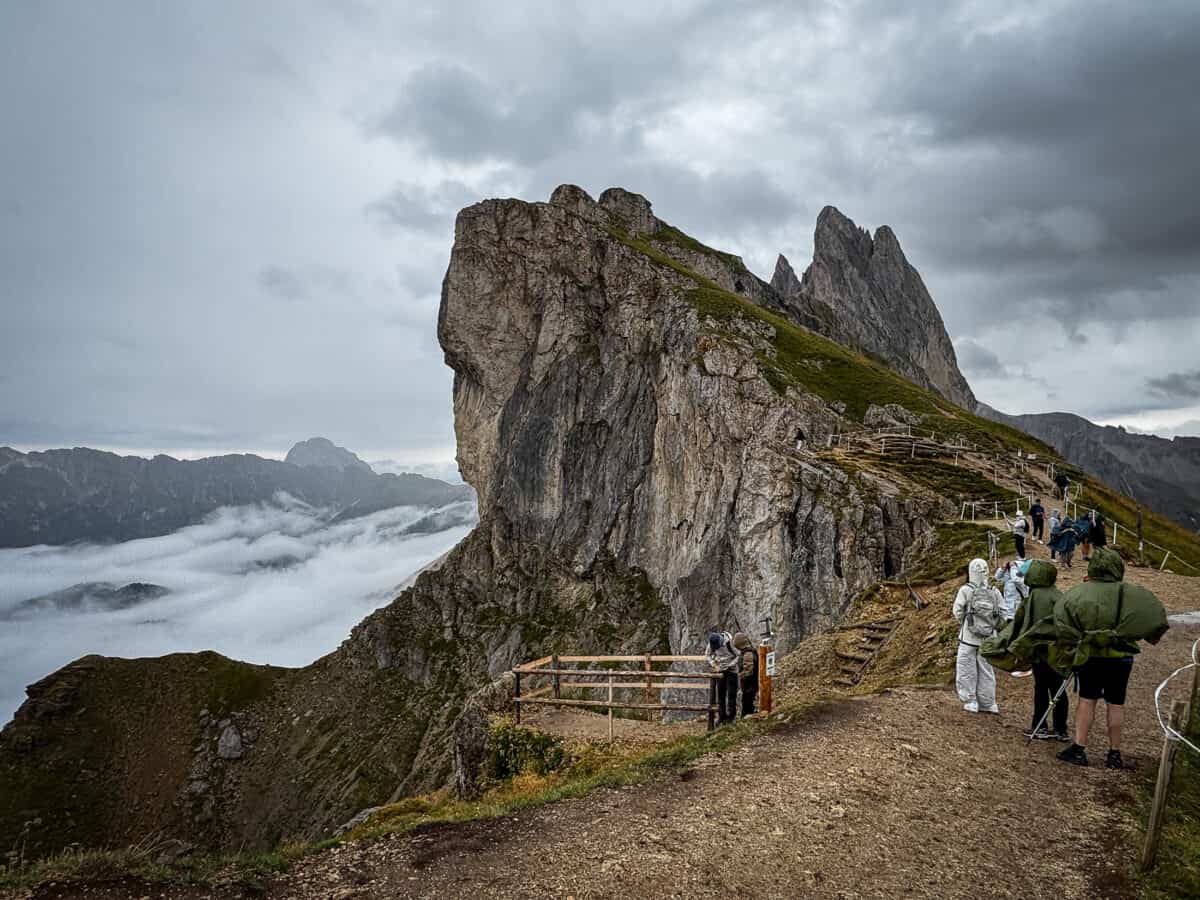
Day 2: Seceda. The most famous ridge in the Dolomites, and the most expensive lift of the trip. The ride up takes about twenty minutes with a change of gondola partway. Our day arrived in cloud, then rain, and we turned back when the trail into the national park turned to mud. On a clear day you could stay up there for hours.
Before You Book a Timed Ticket
A timed ticket won’t let you board more than fifteen minutes before your reserved slot. If the forecast is unstable, that flexibility is worth more than the guaranteed seat. We showed up at 8:40 am for a 9:30 am ticket and stood around until 9:15 am while the weather closed in. In late August we could have bought at the window. In July, a reservation is a good idea.
Day 3: Alpe di Siusi. Europe’s largest alpine meadow and the least technical of the big days. Eight miles of rolling meadow with the Sassolungo group in front of you most of the way. Save something for the end, because the walk back up to the gondola station is a real climb and it comes when your legs are done.
Day 4: Adolf Munkel Weg. Drive thirty minutes to Val di Funes and walk directly beneath the Odle spires. Quieter than the cable car hikes, and the rifugios along it are worth the stop.
Days 5 to 8, the Cortina Area
Day 5: Drive to Colle Santa Lucia. A travel day that doesn’t feel like one, because the route crosses the passes. Stop at viewpoints. This is the day the driving is the point.
Day 6: Cinque Torri & Nuvolau. Up Passo Giau and its twenty-nine tornanti, then a gondola and a loop around the five towers, through First World War battlements, with lunch at a rifugio.
Day 7: Lagazuoi & the tunnels. Cable car up from Passo Falzarego, then descend through the war tunnels inside the mountain. Bring a headlamp and gloves, and collect a helmet at the base before you go up.
Day 8: Tre Cime di Lavaredo. The big one. Reserve parking weeks ahead for the Tre Cime di Lavaredo hike, start early, and allow six hours for the full circuit. Nine miles, 3,400 feet, and the most recognizable rock in Italy.
Days 9 & 10, Siusi
Day 9: Marmolada, then drive to Siusi. Three gondolas to the glacier and a First World War museum on the way up, then the drive the passes to your last base.
Day 10: Alpe di Tires, or nothing at all. Either one more hike from the Seiser Alm, or a spa day and a walk to the castle ruins. We did both across two days and regretted neither.
Related Post: 10 Best Hikes in the Dolomites: Epic Trails & Views
If you have twelve days like we did, add a spa day, visit Cortina, or book Lago di Braies. We skipped the lake because it sat ninety minutes from our base and needed a reservation on a day that was already long, and it’s the one cut I second-guessed.
You’ll need one more day at the end of your Dolomites itinerary to get back to the airport. We broke ours up with a stop in Innsbruck, which is about ninety minutes from Siusi and roughly on the way to Munich.
Gondolas, Lifts & What They Cost

You cannot experience the best of the Dolomites without riding lifts, and they are not cheap. Nearly every famous view sits at the top of a cable car, and several of the best hikes only make sense if you let a gondola do the climbing. Alpe di Siusi is a good example: there is a road up, but access is restricted during the day, so most visitors ride the cable car.
Across twelve days we spent roughly €450 on lifts for the two of us. That’s a significant line in the budget and it’s worth planning rather than discovering.
What the Lifts Cost
| Lift | Access To | Cost Per Person* |
|---|---|---|
| Seceda, Ortisei | Seceda Ridge | ~ €70.50 round trip |
| Mont Sëuc, Ortisei | Alpe di Siusi | ~ €39 round trip |
| Cinque Torri, Fedare Passo Giau | Cinque Torri, Nuvolau & Averau | ~ €18 round trip |
| Lagazuoi, Passo Falzarego | Lagazuoi, WWI Tunnels | ~ €20 one way |
| Malga Ciapela | Marmolada, Punta Rocca | ~ €40 round trip |
| Seiser Alm Bahn, Siusi | Alpe di Siusi | ~ €30 round trip |
| Panorama Lift, Alpe di Siusi | Alpe di Tires side | ~ €12.50 round trip |
*Prices we paid in August 2026. Confirm current prices with the operators for your budget.
Three things worth noticing:
- Seceda is the outlier, roughly double anything else we rode, and it’s the one people assume is standard pricing..
- Alpe di Siusi costs €39 from Ortisei on the Mont Sëuc and €30 from Siusi on the Seiser Alm Bahn. Ride from whichever side you’re staying on, because driving around costs more in time and fuel than the €9 you’d save.
- The Panorama lift on the Alpe di Siusi plateau is a separate system from the Seiser Alm Bahn, so it’s a second ticket.
Carry cash. We paid cash at the Panorama lift when we arrive. Many rifugios don’t take cards either.
Lift Passes & When They’re Worth It
Three passes cover this area, and which one makes sense depends entirely on how you plan to use the lifts.
Dolomiti SuperSummer is the big one, covering around 140 lifts across twelve valleys from mid-May to early November. A day ticket is €67, three days out of four is €145, five out of seven is €185, and a season pass is €415. It’s the only pass spanning multiple valleys, so it’s the one to look at if you’re moving between bases.
The Gardena Card covers seventeen lifts in Val Gardena for three or six consecutive days. Worth checking what’s included before you buy, because the Alpe di Siusi lift is not on it.
The Cortina Vertical Pass covers the Cortina area, including Lagazuoi, Cinque Torri, Faloria and Freccia nel Cielo, and sells as flexible non-consecutive days.
Check what’s left off before you buy. Seceda, the most famous and most expensive lift in the range, is not on the SuperSummer pass. The Gardena Card doesn’t cover the Alpe di Siusi lift. In both cases the ride people most want is the one excluded.
What decides it is how many lifts you ride in a day, not how many days you’re there. These passes are priced for people stacking several rides into one day, which is how bikers and lift-linked hikers travel. If your plan is one lift up and then walk all day, you rarely reach the break-even.
Our heaviest lift day was two rides on the Alpe di Siusi, €42.50 between them. A SuperSummer day ticket that day would have been €67. If a pass can’t win on your busiest day, it won’t win on the others.
Count your own lift days before you buy. We bought singles every time.
Cable Car Hikes Run Backwards
A normal trailhead hike climbs first and descends as you head back to the trailhead. A gondola hike does the opposite. The lift drops you at the high point, the best walking is below it, and the last thing you do is climb back up to the station with nothing left in your legs.
Seceda and Alpe di Siusi both ended that way, and both times the return felt longer than everything that came before it. Pace for it.
It’s also worth checking whether a one-way ticket is an option before you commit to a loop. At Lagazuoi we rode up, walked down through the tunnels, and never went back to the top station, which is both cheaper and a better day.
One-way tickets aren’t always half price either. The Panorama was €8 up and €4.50 down, so the ride up is the expensive half. Walking up to save money saves less than you’d think.
What I’d Add Next Time to a Dolomites Road Trip
Nothing about this route needs fixing. I’d hand it to someone else exactly as written. But I don’t tend to do the same trip twice, and there were a few places we skipped on purpose and a couple we didn’t get to see properly.
Lago di Braies. The one I second-guessed. It sat ninety minutes from our base and needed a reservation on a day that was already long, so we found a closer lake instead and soaked our feet in it. No regrets about that afternoon, but it’s the famous one and I still haven’t seen it. If you want it, build your route so it isn’t an add-on to a big hiking day.
Lago di Sorapis. Cut for the same reason most people should think twice about it: it’s near Cortina, it’s popular, and we had better options closer to Colle Santa Lucia. It would fit naturally into a trip based further east.
Piz Boè. A 3,000 metre summit reachable from Passo Pordoi, which we drove past on a transfer day with the energy for exactly none of it. Next time it goes on a day of its own rather than tacked onto a drive.
Seceda, in good weather. We paid for the most expensive lift of the trip and rode it into cloud and then rain. I’ve seen the ridge. I haven’t seen the view. That alone would get me back.
Marmolada, in clear weather. Three gondolas up to the glacier and we spent most of it inside a cloud, with occasional gaps where the blue came through. The First World War museum at Serauta was worth the trip on its own, but I’d like to see what’s actually up there.
When to Visit for a Dolomites Holiday
The lifts run from roughly mid-May to early November, and that window is your season. Outside it the cable cars close, the high passes shut, and the Dolomites become a ski destination instead. Ortisei is a serious ski town in winter, which is a different trip entirely.
We went in late August, which is worth understanding before you copy it. It is high season, and not only for the reason Americans assume. Italians take their own holidays in August, so the towns stay busy right through the month, and we heard every language on the trails. If you are picturing empty meadows because the school year has started back home, adjust.
What you get in exchange is everything being open, every lift running, and longer daylight hours.
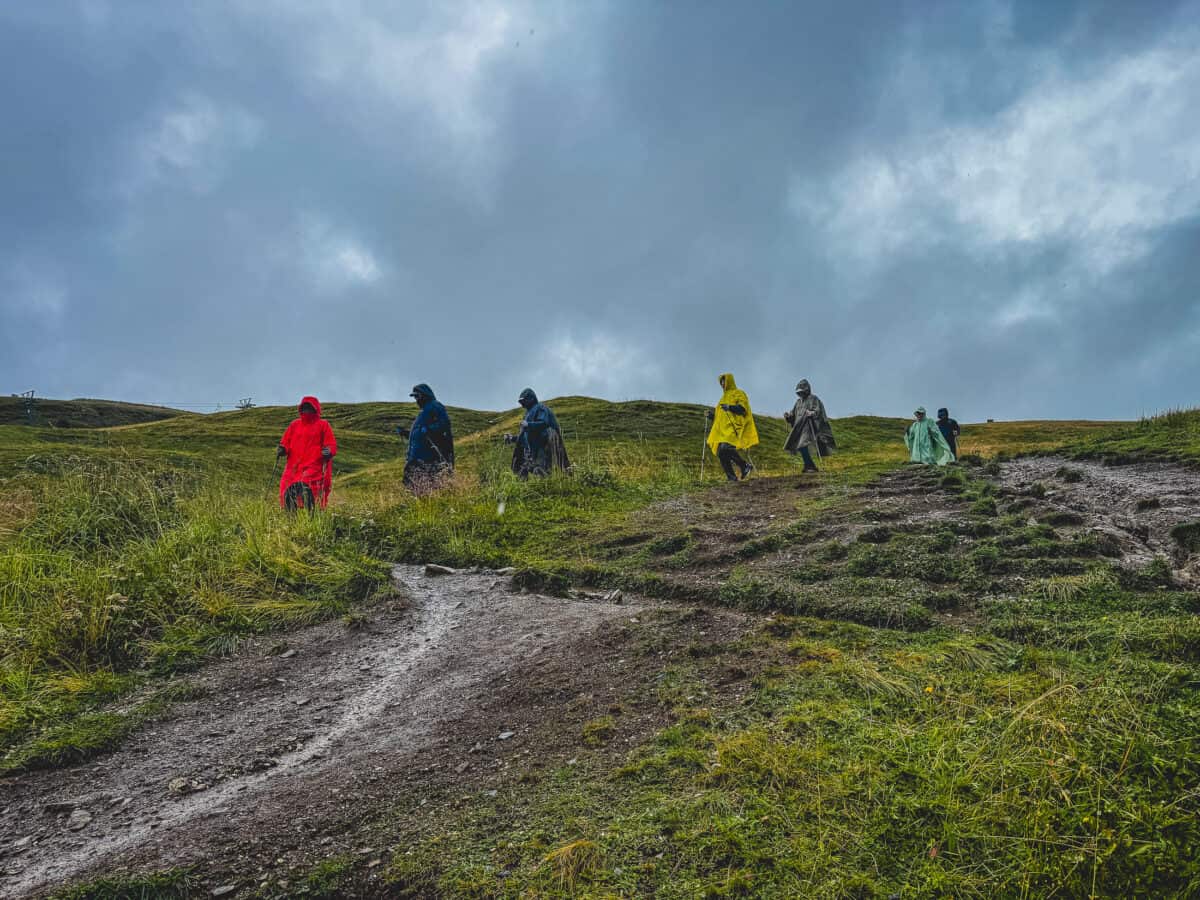
The weather is the part to plan around. We had driving rain on our first full day, blue sky and white clouds the next, then cloud and drizzle again mid-trip. That is normal here rather than bad luck. Forecasts more than two days out were close to useless.
Dress for it. The temperature difference between the valley and the top of a gondola is dramatic, and the wind at altitude does the rest. We put on puffy vests and rain jackets the moment we stepped out at Seceda, and I spent the morning wishing I had packed the gloves sitting in my suitcase. In August.
If you can travel in September, the crowds thin noticeably once Italian holidays end and the light gets better for photographs. Early October is beautiful and colder, but our research showed that many lifts and rifugios close for the season. That matters more than it sounds. Those huts are where you eat lunch, use the restroom, and refill water, and a closed rifugio turns an easy day into one where you carry everything yourself.
Italy Quick Facts
- Official Language: Italian
- Capital City: Rome
- Population: 58.9 million
- Currency: Euro (€ or EUR)
- Power Outlet: Type L (3 round prongs) is standard and Type C (2 round pins)
- Emergency Number: 112
- Drive on the: Right side of the Road

Frequently Asked Questions
How many days do you need in the Dolomites?
Ten is comfortable and lets you split between two or three bases without feeling rushed. Seven works if you stay in one valley and accept that you’ll miss the Cortina side. Fewer than five and you’ll spend a disproportionate amount of it driving passes, because the valleys are separated by mountains rather than distance.
Do you need a car in the Dolomites?
Yes. Buses exist between the larger towns, but trailheads, passes, and the smaller villages are effectively unreachable without one, and the timing rarely works for a hiking day. There is no version of this trip I’d attempt without a rental.
When is the best time for a Dolomites holiday?
Mid-June through September, when the lifts run and the passes are open. Late August is beautiful and busy, since Italians take their own holidays then. September thins out and photographs better. By October you start losing lifts and rifugios to the season.
Do you need to book gondola tickets in advance?
It depends on the month. In late August we could have bought at the window every time, including at Seceda. In July or over holidays, book. Just know that a timed ticket may not let you board more than fifteen minutes before your slot, so booking ahead trades flexibility for certainty.
Is a Dolomites lift pass worth it?
Only if you ride several lifts in a single day. The passes are priced for bikers and lift-linked hikers. We rode one lift most days and then walked, and buying singles came out cheaper every time, including on the day we rode two.
Do you need to speak Italian?
No. German is as common as Italian here and English is widely spoken in hotels, lifts, and restaurants. Menus and signs are usually in at least two languages. You’ll get further with a little patience than a phrasebook.
Are the Dolomites worth visiting if you don’t hike?
Yes, with a real limit. A gondola puts you on top of the mountain and the view from the station is genuinely good. But the viewpoints people photograph are almost always a walk beyond it. Seceda’s ridge is about ten minutes from the top station. Tre Cime is a six-hour circuit. The pass drives are spectacular from inside the car, so a non-hiking trip absolutely works. Just expect the view from the station rather than the one on the postcard.
Love this Post? Pin it!
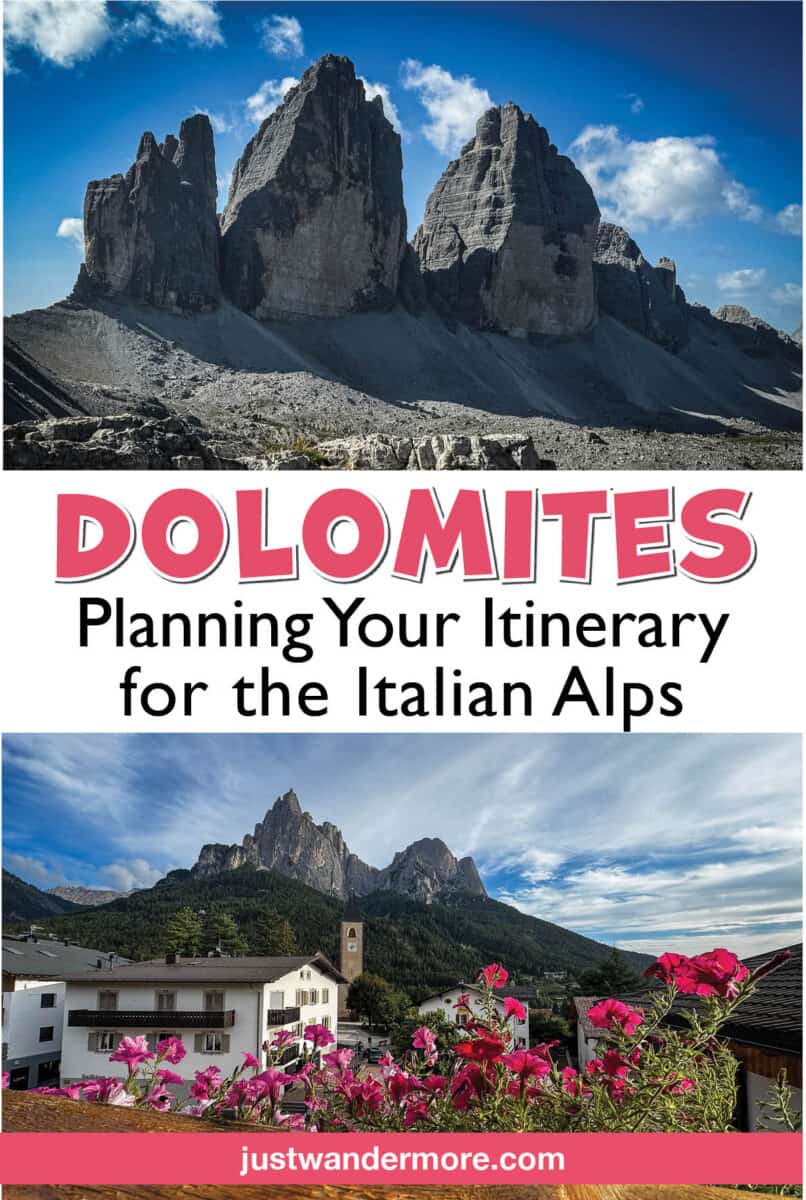
The Dolomites Are Calling. Don’t Forget the Gloves.
The Dolomites gave us rain on the most expensive gondola of the trip, a trailhead full of police waving cars away, and five improvised footholds I will be thinking about for a long time. They also gave us twenty-nine numbered hairpin turns, a meadow that took eight miles to walk around, and church bells at 5:30 in the morning whether we wanted them or not.
I’d send anyone here. I’d just tell them to plan and pack properly. Which brings me back to those gloves. They were on my packing list. I brought them to Italy. They were also sitting in my suitcase in Ortisei while I stood on the Seceda ridge with cold hands, which is an entirely different kind of failure.
You can grab my Dolomites packing list here. Gloves are on it, for warmth and for the tunnels at Lagazuoi. Whether they make it into your pack is between you and your morning self.
You may also love…
- 15 Best Cities & Towns in Northern Italy You Need to Visit
- 30 Essential Tips for Driving Through Mountains
- 29 Best Day Hikes in the World to Stay Fit as You Travel
- Best Travel Backpack for Europe, Adventures & Hiking
- 15 Most Beautiful Places in Italy for Photographers
- 17 Most Beautiful Swiss Villages Plus Surprising Adventures
- Switzerland Itinerary: Legendary Chocolate, Castles & Queen