
Europe has no shortage of gorgeous cities, but it’s the smaller towns that tend to steal your heart completely. Cobblestone streets, flower-draped window boxes, medieval architecture frozen in time—these are the places that make you slow down, wander without a map, and wonder why you ever bothered with the crowded capitals.
From the fairy-tale canals of Bruges to the clifftop drama of Orvieto, these charming old European towns span eight countries and deliver the kind of old-world magic that has kept Chris and me coming back to Europe again and again.
17 Charming Old European Towns to Explore
This page may contain affiliate links. If you choose to click on one of the links and then make a purchase, Just Wander More may earn a small commission. The commission is paid by the company at no extra expense to you. Read the full disclosure here.

These towns were chosen for their character, beauty, and the kind of atmosphere that makes Europe impossible to forget. Whether you’re building your first European itinerary or adding new destinations to a well-worn passport, there’s something on this list for every type of traveler. If you’re still in the early stages of planning a trip to Europe, my step-by-step guide is the perfect place to start before diving in.
1. Annecy, France
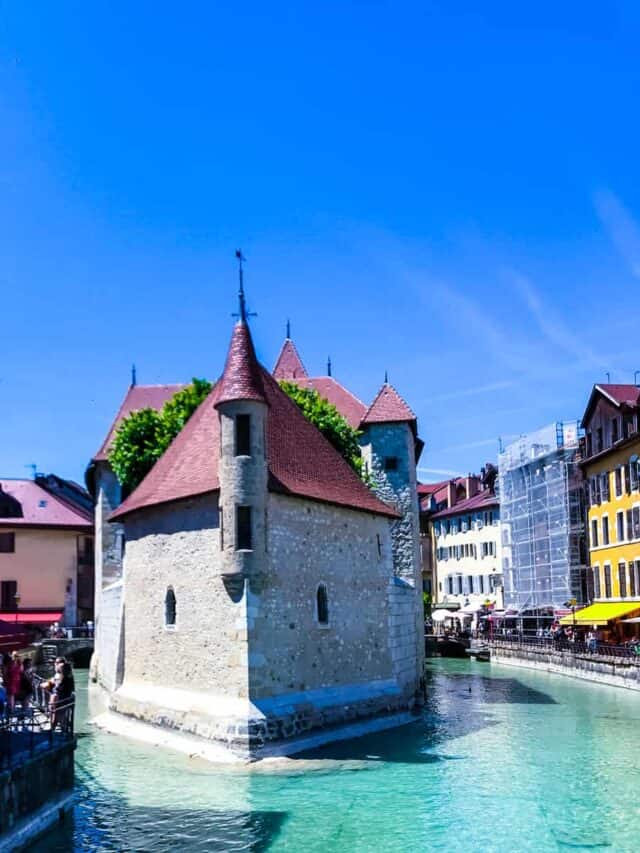
Annecy has a charming beauty all its own. Strolling the canals of the Vieille Ville (Old Town), you’ll find bridges blossoming with flowers, tiny shops and eateries, and the aroma of fresh-baked pastries drifting through the streets each morning—enchanting Europe at its most picturesque.
And then there’s Palais de l’Isle, one of the most photographed old buildings in Europe. This small castle sits on a tiny island in the middle of the Thiou River and is exactly as magical as it looks in every photo.
Check availability: Private Walking Tour of Annecy’s Historical Center with Viator
2. Bruges, Belgium
Bruges is one of the most enchanting old European towns in Europe—and one of the easiest to fall completely in love with. Often called the Venice of the North, this Belgian gem delivers cobblestone streets, picture-perfect canals, and enough chocolate shops to make any afternoon decadent.
Things to do in Bruges:
- Visit the picturesque Wijngaerde’ Beguinage.
- Take a horse and buggy ride through the cobbled streets.
- Browse the weekly market.
- Take a canal boat tour
- Discover the Bruges Photo Point at the corner of Rozenhoedkaai Street and Huidenvettersplein town square – Quay of the Rosary
- Climb the 366 steps of the Belfry of Bruges
- Visit the Historium Museum and climb the Historium Tower
- Discover the instagrammable Blinde Ezelstraat (The blind donkey street)
- Visit the windmills
Check availability: Belgian Chocolate Workshop in Bruges
3. Colmar, France

Colmar’s Old Town is one of those places that doesn’t feel entirely real. Half-timbered buildings in every color line the canals of Petite Venise, flower boxes overflow from every window, and the cobblestone streets invite you to wander with no particular destination in mind.
Colmar is one of the many pretty French villages you absolutely need to visit; it might just remind you of a Disney fairytale. Start in Petite Venise, where colorful half-timbered buildings line the canal and flat-bottomed boats drift past flower-draped facades. From there, wander the cobblestone streets of the Old Town, pop into the boutiques, and don’t skip the patisseries—traditional Alsatian biscuits are worth every bite.
Things to do in Colmar:
- Cruise the canal on a flat-bottomed boat.
- Experience the markets in the Alsace region.
- Relax at Champ de Mars park.
- Visit the Bartholdi Museum—Colmar’s most famous son created the Statue of Liberty
- Visit Pfister House with its colorfully painted facade and octagonal turret.
Popular * 2 Hour Segway Tours in Colmar
4. Ghent, Belgium

When Chris and I arrived at the Marriott in Ghent, it was quite late at night. From the entrance, the exterior of the hotel had a modern look to it. We planned our stay at this Marriott using hotel reward points. Want to know how to maximize your travel reward points? Here are 10 Super Smart Travel Hacks to Plan the Perfect Trip using reward points.
Book your stay at the Ghent Marriott Hotel
The next morning, Chris and I went down for breakfast in the hotel restaurant. From the front entrance the hotel gave off a totally modern vibe; inside the lobby, it was a spectacle of glass and structure. Ghent wasn’t immediately living up to the hype of featuring old buildings in Europe.
And then we walked to the back of the hotel.
In the restaurant, we stepped back in time. We found the charming beauty of stained glass windows, wide-plank wood floors, and rustic beamed ceilings as we sat down to breakfast. Apparently, Marriott had purchased three row homes along the canal and refurbished the homes into a hotel, keeping the rear of the hotel exterior as it had once been.
Chris and I exited at the rear of the hotel after breakfast and walked into a medieval storybook setting with the buildings, the canal, the cobblestone streets, and the beautiful sunshine. It was, without question, one of the most enchanting old European towns we had ever wandered into.
Things to see and do in Ghent:
- Walk along Korenlei Street
- Visit Korenmarkt
- Tour St. Nicholas’ Church
- Visit St. Bavo’s Cathedral
- Take a boat tour along the canal
Love Chocolate? Try a Ghent Small-Group Chocolate Tour with a Local Guide
5. Hallstatt, Austria

Hallstatt is one of the beautiful old European towns tucked into the mountainside next to Hallstatt Lake in the Salzkammergut Region of Austria. Hallstatt is famous for its salt mines. Just as we arrived on the main street of town, rain started with a few drops here and there, and then it just poured. Good thing we had our rain jackets and umbrellas.
We stood under a tree on the patio of a restaurant, keeping dry and watching as the wait staff secured the outdoor seating area. The tourists hurried back to their cars and the streets of this charming old European town were left bare except for a few patient tourists such as ourselves who had waited out the rain. It was like watching ants pouring out of an anthill!
It took about a half an hour for the rain to stop, and when it did, we had most of the town to ourselves. And it was delightful. Hallstatt has been named the most Instagrammable town in the world. As such, it is often overrun by tourists. It was a blessing in disguise to have a rainy day for our visit.
Hallstatt Ancient Treasures: City Exploration Game or Love Stories of Hallstatt Tour
6. Lourmarin, France

Lourmarin, nestled in the Luberon Valley, is about one hour from Aix-en-Provence. The Luberon Valley offers the most enchanting European towns in France, one town after another of picturesque, charming beauty.
As Chris and I drove, we enjoyed the beautiful vineyards with yellow changing leaves, olive groves, apple orchards, and rolling hills. We were both enchanted with Lourmarin.
Because I tend to wander about with my camera wherever I travel, I especially loved the charm of Lourmarin. It was just a lovely little village with the cutest shops. I was telling Chris that the French really know how to create a vignette to draw you in to their stores, as well as picturesque scenes as you drive to make the passing countryside even more beautiful.
Check Availability: Provence Wineries and Luberon Villages Day Trip from Aix-en-Provence
7. Lugano, Switzerland

Tucked along the shores of Lake Lugano and surrounded by mountains, Lugano is one of those old European towns that feels like it belongs to two worlds at once. Located in Switzerland’s Italian-speaking Ticino canton, it blends Swiss precision with Italian warmth—and the result is completely irresistible.
Often called Switzerland’s “Little Italy,” Lugano brings together the best of both cultures in its architecture, its food, and its relaxed pace of life. It’s the kind of place where you can hike in the morning and linger over a long lunch by the lake in the afternoon.
Things to do in Lugano:
- Photograph the lakefront along Lake Lugano.
- Ride the funicular up to Monte Brè for panoramic views.
- Hike the trails above the lake.
- Take a ferry around Lake Lugano.
- Stroll through the gardens of Parco Ciani.
- Treat yourself to a Thai massage—yes, really.
Book the Full Day Lugano, Bellagio and Cruise Experience from Como
8. Mdina, Malta

I loved Mdina.
Mdina (pronounced Im-dina) was one of the most impressive sites in Malta during our visit—a beautiful fortress city set up on a hill, with stone walls and walkways, gorgeous doors and windows, impeccably clean streets, and horse and buggy rides through the lanes. What made it even more remarkable is that people actually live within the walls of this fortress city.
And then there’s that blue door with the bougainvillea climbing the wall—one of the most instagrammable spots in all of Malta.
>> Related Post: 25 Brilliant iPhone Travel Photography Tips You’ll Actually Use
Malta Private Minivan Tour: Popeye village, Mdina, Valletta & More
9. Monterosso al Mare, Italy

As we exited the train station in Monterosso al Mare with our bags in tow, we walked straight out to the waterfront of the “newer” section of town—and the colorful buildings, the sea, and the energy of the piazza made it impossible to put the camera away.
Monterosso is the most beach-friendly of the Cinque Terre villages, making it the perfect base if sunbathing or swimming is on your agenda. We found a vacation rental right in the heart of the old town and it was the ideal spot to return to after a day of exploring.
>> Related Post: 17 Dreamy Small Towns in Italy Near Florence
Chris and I LOVED this! Cinque Terre Sunset Boat Tour Experience
10. Orvieto, Italy

Orvieto is one of those old European towns that announces itself before you even arrive—perched dramatically atop a rupe (a steep volcanic cliff), it’s visible for miles. The easiest way up is the funicular from the train station.
Pro Tip * Did you know that you can often buy funicular tickets at a magazine stand if one is close by? You will save some time if everyone else is standing in the line at the funicular ticket office.
Things to do in Orvieto:
- Stop at a bakery and enjoy some bread before continuing on toward the Duomo. Not a must, but you’ll thank me when you do.
- Explore the Duomo inside and out. The exterior has an stunning striped facade.
- Purchase tickets for an Underground Cave Tour. Most of the homes in Orvieto have caves dug out underneath (following strict specifications). Today they are used for storage and wine cellars, but years ago they were used for olive oil production with olive presses, cold storage, and pigeon nests.
- Wander the streets and walk along the borders of the city. From here, you can see all of the surrounding countryside.
Check availability for a Cathedral and Underground Cave Tour with Viator
11. Prague, Czechia

Discover the fun and sometimes unique things to do in Prague during your visit. Beyond the famous Astronomical Clock and Charles Bridge, there’s a whole city worth exploring.
- See the Prague Astronomical Clock
- Explore Charles Bridge and Karlova Street
- Visit the Jewish Quarter and cemetery
- Shop at the Havel Market
- Discover the Prague Castle & the Golden Lane
- Check out Queen Anne’s Summer Palace
If Czechia is in your sites as a potential destination, you will love visiting the beautiful city of Prague. You will find plenty of things to do in Prague as you discover its rich history, striking architecture and old buildings in Europe, and vibrant people.
Are you a Foodie? Try the Prague Foodie Tour
12. Riquewihr, France

On our way from Strasbourg, France to Freiberg, Germany we stopped at two charming European towns—Colmar and Riquewihr. The scenery was beautiful as we rolled through the French countryside by bus from Colmar to Riquewihr. We stepped off the bus into a fairy tale of an enchanting Europe village.
Riquewihr has been classified as one of the most beautiful villages in France or Les Plus Beaux Villages de France. And you could see the charm the moment you stepped under the arch into Riquewihr.
We spent the afternoon happily wandering the cobblestone streets, taking pictures, and checking out the many shops. It did get busier later in the afternoon—arrive early if you can.
Riquewihr: Private Guided Walking Tour
13. Rovinj, Croatia

Rovinj (pronounced ro-VEEN) was one of those happy discoveries that happens when you take a tip from someone who actually grew up in the place. Thanks to a suggestion from a coworker of Chris’, we spent three days on Croatia’s Istrian Coast—and left wishing we had more.
The car-free Old Town of Rovinj is a tangle of cobblestone alleys, colorful buildings, and steep hills that lead up to the bell tower of St. Euphemia Basilica at the tip of the peninsula. The harbor below is pure eye candy at sunset. Even the beaches—mostly slab rock and pebbles hugging the coastline—have their own rugged charm.
Rovinj feels more Italian than Croatian, which makes sense since it belonged to the Kingdom of Italy from 1918 to 1947. That influence is felt everywhere, from the architecture to the fresh pasta on every menu.
Sunset & Dolphin Boat Tours in Rovinj, Croatia
14. Segovia, Spain

Segovia makes a perfect day trip from Madrid—hop on a fast train from Chamartín Station and you’re there in under 30 minutes.
We arrived on a chilly November day with temperatures in the 40s and a plan: skip the crowds at the Aqueduct, head straight for the Alcazar at the far end of town, and work our way back. It worked perfectly.
The Alcazar of Segovia, one of the most dramatic old buildings in Europe, reportedly served as inspiration for Disney’s Cinderella castle, and standing in front of it, that’s easy to believe. We bought tickets that included an audio tour, explored the castle, and climbed to the top for sweeping views of the city. After the necessary picture-taking, switching back and forth between my camera and my smartphone camera, we made our way down the stairs and back to the base of the Aqueduct.
The Roman Aqueduct, built around 50 BC, is remarkably well preserved. Two tiers of arches constructed from un-mortared granite blocks have stood for over 2,000 years…no mortar, no bolts, just precise engineering and gravity holding the whole thing together.
Hot Air Balloon Ride over Segovia with Optional Transport from Madrid
Best Cameras for Travel
Point & Shoot Cameras — The pocketable PowerShot SX740 HS is a do-it-all compact with 4K video and impressive zoom range. No lens swapping required. For a step up in performance, the Canon PowerShot V1 delivers better image quality and video in a still-compact body.
DSLRs — One of the lightest DSLRs on the market, the Canon Rebel SL3 has a great battery life, a vari-angle touchscreen, and solid image quality in a comfortable grip. Ready to go full-frame? The Canon EOS 6D Mark II (my current camera) delivers professional-level image quality with a fully articulating screen and impressive low-light performance—a favorite among travel photographers who don’t want to make the jump to mirrorless just yet.
Mirrorless Cameras — The Canon EOS R50 is the sweet spot for travel: 24.2MP, 4K video, lightweight, and beginner-friendly without sacrificing quality. Step up to the Canon EOS R8 if you want full-frame performance in a carry-all-day body, or the Canon EOS R7 for serious action and wildlife shooting at 32MP.
Adventure & Underwater Cameras — Built for the moments when your camera needs to keep up with you. The GoPro Hero 13 is waterproof, shockproof, and small enough to clip anywhere—perfect for hiking, rafting, snorkeling, or any activity Chris talks me into!
Phone Camera — Arguably the best camera is the one you always have with you. Today’s smartphone cameras are genuinely impressive, and for social media and quick shots, they’re hard to beat whether you’re shooting with an Apple iPhone, Samsung Galaxy, or Google Pixel.
Check out my Photography Gear on Amazon for more ideas and recommendations.
15. Tavira, Portugal

Tavira was one of those towns that required a second look. The first time Chris and I drove through, we were underwhelmed. It wasn’t until we parked near the Old Town and set off on foot that Tavira came alive with cobblestone streets, whitewashed homes draped in brilliant bougainvillea, a Roman bridge spanning the Gilão River, and a ruined castle sitting at the highest point in town.
One of the oldest towns in Portugal, Tavira carries centuries of Phoenician, Roman, and Moorish history in its streets and architecture. It’s quieter and more authentic than much of the Algarve coast.
From the Old Town, you can take a ferry out to Ilha de Tavira for some of the best beaches in the region, or wander down to Santa Luzia for fresh seafood along the waterfront.
Try Something Fun. Book a Vacation Photographer in Tavira
16. Varenna, Italy

Varenna will have you at hello.
Every walkway, doorway, and passageway in this Lake Como village is a photographer’s dream—narrow staircases, crumbling stone walls draped in ivy, and in the fall, grape leaves turning red and gold in the afternoon light. I explored on my own while Chris had meetings further north, and wandering solo with no agenda was one of my favorite days in Italy.
From Varenna, the stunning beauty of Lake Como stretches in every direction, with ferries connecting to Bellagio and Menaggio just a short ride away.
Italian Cooking Class in Varenna
17. Yvoire, France

Yvoire sits nestled along the shore of Lake Geneva with a population of around 800 people and absolutely zero traffic—just medieval walls, gates, a castle, and cobblestone streets that beg to be wandered slowly. It has the kind of scale that lets you feel like you’ve discovered something the rest of the world hasn’t found yet.
I loved exploring the shops and art studios, and the views of Lake Geneva from the village are worth the trip on their own. If I ever make it back to this corner of France, I’d find a vacation rental in Yvoire and stay for a week.
Book a Geneva City & Yvoire Tour
Getting to & Around Old European Towns
One of the best things about exploring old European towns is how well-connected most of them are. Europe’s rail network is extensive, efficient, and often the most scenic way to travel between destinations.
By Train
For towns like Segovia, Hallstatt, and Varenna, the train drops you close enough to walk straight into the charm. Rail passes through Eurail give you flexibility to hop between countries without the stress of navigating unfamiliar roads.

By Car
For destinations like Lourmarin, Riquewihr, and Yvoire—where the joy is as much in the drive through the countryside as the destination itself—renting a car gives you freedom that trains simply can’t.
Find the best rental car rates in Europe →
Pro tip: Many old European towns are partially or fully car-free once you arrive, so plan to park at the edge of town and explore on foot. Comfortable walking shoes are non-negotiable on cobblestone streets.
Travel Must-Haves
Sunscreen: Use sunscreen every day, not just on your beach days.
Laundry Detergent Pods: If you travel for more than a week, you will likely need to do laundry.
Hand Sanitizer: For all the things you touch throughout the day, hand sanitizer is essential.
Travel Adapter: Not all international countries use the same adapters. Be sure to check before you go. Purchase one here.
Travel Backpack: Chris likes his The North Face Recon Backpack. I use The North Face Surge backpack designed for women.
Crossbody Anti-Theft Bag: Pickpocketing is a real concern in busy cities. A secure crossbody bag keeps your belongings close without the bulk. I love the Travelon Anti-theft Messenger Bag.
Packing Cubes: A game changer for staying organized, especially when you’re moving between cities. Shop packing cubes here.
Portable Power Bank: Long days of sightseeing, navigation, and photography will drain your phone faster than you think. Don’t get caught without one. Shop power banks here.
Walking Shoes: You will cover a lot of ground. Comfortable, broken-in shoes are non-negotiable. Shop walking shoes here.
Favorite Camera: My go-to DSLR is the Canon 6D Mark II and it has never let me down. If you’re ready to go mirrorless, the Canon EOS R6 Mark III is the natural upgrade—and your existing Canon EF lenses work on it with an adapter. New to photography? Start with the Canon EOS R50.
Get a Travel Credit Card: We often travel worldwide for free using travel rewards. The Chase Sapphire Reserve is one of our favorite travel credit cards.
Favorite Electronics: Chris and I are Apple users—watches, phones, tablets, AirPods, and Apple AirTags for security. Don’t forget the cables and chargers too. Check out my electronics suggestions here.

Frequently Asked Questions
When is the best time to travel to Europe?
The best travel months for much of Europe are May, June, September, and October. They will be busy though, so if you prefer quieter travel experiences, the off-season months of April and November are great too.
Are walking tours in Europe worth it?
Definitely. Walking tours deliver history, hidden stories, and local perspective you simply won’t get on your own. They’re a great option if you’re traveling solo as well.
How much should you tip for a “free” walking tour?
The amount varies depending on the length of the tour, group size, and how much you enjoyed it, but tipping $5–$20 per person in your group is generally considered appropriate. Even with a tip, a free walking tour is typically far less expensive than a paid group or private tour.
What is the best way to travel between old European towns?
Train travel is by far the easiest and most scenic option for moving between towns in Europe. Regional trains connect most destinations, and high-speed rail makes longer distances surprisingly manageable. Renting a car gives you more flexibility for off-the-beaten-path stops, especially in rural France or the Algarve region of Portugal.
Do you need to speak the local language to visit small towns in Europe?
Not at all. English is often spoken in most tourist areas across Europe, even in smaller towns. A few words of the local language—hello, thank you, please—go a long way and are always appreciated by locals.
How many days should you spend in a small European town?
One to two days is enough to see the highlights of most small European towns, but if you want to slow down and truly soak it in, three days gives you time to explore without feeling rushed. Some towns—like Rovinj or Tavira—are worth using as a base for several days of regional exploration.
Are old European towns accessible for people with mobility concerns?
Many old European towns feature cobblestone streets, steep hills, and uneven terrain that can be challenging. That said, most towns have at least some flat areas and accessible routes. It’s worth researching specific towns in advance and contacting local tourism offices for current accessibility information.
Love this Post? Pin it!

Your European Adventure Awaits—The Hardest Part is Choosing Just One
I would happily return to every single town on this list. Each one delivered the cobblestone streets, the charming beauty, and that particular old-world atmosphere that makes Europe so endlessly compelling.
Whether you’re drawn to the clifftop drama of Orvieto, the lakeside magic of Varenna, or the hidden corners of Rovinj, the hardest part of planning a European trip is narrowing down the list. But that’s a good problem to have.
Do you have a favorite charming old European town that didn’t make this list? Drop it in the comments—I’m always looking for the next one to add to my itinerary.
Planning a trip to Europe? My free Europe trip planning guide walks you through everything you need to know before you go so you can spend less time stressing and more time wandering.
You may also love…
- 15 Most Beautiful Places in Italy for Photographers
- 23 Instagram Worthy Beautiful Lakes Around the World
- 25+ Best Things to Do in Malta—Chasing Sunshine, Coastlines, & Hidden Gems
- 15 Charming Small Towns in France Near Paris
- 17 Dreamy Small Towns in Italy Near Florence
- 40 Charming and Romantic Things to Do in Europe
I am currently stationed in Germany & cannot wait to explore more of Europe when COVID-19 restrictions loosen up. Definitely adding all of these charming places to my must-visit list! Thank you for sharing!
They were all amazing. How exciting for you to be stationed in Germany.
These places look beautiful! I’ve only been to a few spots in Europe and am hoping to get to go back for much longer one day!
I would happily return to all of these places.
Can’t believe I live in the Netherlands and still haven’t crossed over to Belgium! I really need to go! Hopefully now that vaccinations are on track I can get back to it 🙂
Hoping that I can get back to Europe within the next year. I have missed it tremendously.
I’ve only been to Paris in France so far, but I really want to explore some of the smaller towns! They look so pretty!
There are so many amazing smaller towns. I would love to spend a month just exploring them all!
Hallstatt looks absolutely stunning. I would love to visit! I’ve been to some of the bigger cities in Europe but would love to return to explore some of the charming towns. Thanks for sharing!
I love Europe for all of its hidden towns. Segovia sounds wonderful and the castle is definitely fairytale material. I can see why it gave Disney some inspo
That castle definitely looks like something straight out of a cartoon and the aqueduct looks amazing.
Such beautiful photos! And a wonderful guide. Will keep these places in mind for when I’m travelling around the region.
Agreed. I hope that you can visit some of these places.
I’m going to France in December and we’re planning on spending a day or two in Colmar. I’m so excited, it looks like such a cute town!
Ohhhh, hopefully you will get to some Christmas markets!
That castle in Spain looks incredible! I love lists like this… small and charming towns that aren’t as “popular.” THere are so many hidden gems if you can get past the tourist attractions in the big city. THank you for sharing this! – Linzey @thefamilyfuntour
I would much rather explores these charming towns.
I’ve yet to go to Europe, but when I do I plan to travel slow and for a while and these places look so so charming! So this will definitely be helpful. Saving for the future!
I hope that you can make it to all of them!
I am absolutly obsessed with Colmar & Riquewihr now! I had never heard of these adorable French towns, but I’m so happy I’ve now discovered them, and so many other ccharming European towns that are off the beaten path!
I was absolutely thrilled to discover all of these locations. Makes my photographer heart happy!
We love Segovia. So glad to made your list. Will definitely need to check out Ghent.
Ghent was so awesome. Just like walking into a fairy tale.
Sign me up for all of these! They all sound so lovely, but I think Hallstatt and Segovia are at the top of my list! So beautiful!
I’d love to go back to any of these locations.
I’m with you. Just excited to get back to traveling!
Wow! There are just so many places to see on your blog. It was very surprising to learn how they divided class status before in Cours Mirabeau. The Les Baux-de-Provence looks amazing too!
It was an awesome trip. There would be so many more places to visit that we didn’t get to the first time.
I always love to get suggestions for charming towns to visit. And since we have only visited Hallstatt, there were some great new European suggestions on this list. I love the small quaint villages with charm and local sights and tastes. Great for day trips or a short stay.
The Aqueduct looks really nice, I’d like to see it! Haven’t been to Spain or France yet but they are high up on my list. Thank you for sharing!
I would to explore all of them! It’s definitely time for a return trip to Europe.
Ohhh! So many cute places to add to my bucket list! I have never heard of Yvoire, but sounds lovely.
I have only been to three of these charming towns and I want to see them ALL. Thanks for the info.
The color of the water in Annecy is so inviting. The castles at Segovia look amazing, I think I might have to add it to a future itinerary.
From the 15, I have only visited, while I live in Europe. Other charming European towns are Hindeloopen, Leiden, Maastricht (all in the Netherlands), Cesky Krumlov (Czechia) and Castellane (France).
What a fantastic resource. I love European towns, the old cobbled roads, the quaintness, you’ve captured it so beautifully.
All these towns seem right up my alley! Adding these to my destination list.
These all look and sound so cute! I have only done Hallstatt, but now the others are on my radar!
Love reading all about your adventures. They look so relaxing and fun! Great post!
I’ve been to quite a few of these (perks of being European) but nothing beats the small towns in France and Italy!
I have not been to all of these but I hope to! Great choices and beautiful phots. I’m planning now!
I haven’t visited any of these beautiful towns yet. I’m going to have to spend more time in Europe!
You rebranded as Just Travel More! This post is a great example of why Europe is your happy place.
So many beautiful towns to visit in Europe – I’ll have to move there!
What an inspiring list! My current favorites are Mdina and Colmar, and I also hope to visit Hallstatt and Lugano soon (I feel like both also belong on my list of favorites)! I have never heard of Yvoire though, so thanks for sharing new lesser-known spots!
I’m in love with all 15 of these charming old European towns! And I haven’t explored any of them…yet! Definitely all going on my list!
Oh my goodness! These are all so beautiful! I would love to visit each of these.
That picture from Annecy, France is gorgeous! I have only really been to major cities in Europe (fortunately and unfortunately). Your post definitely has reminded me of the benefit and beauty of visiting some of the smaller towns.
Take me to them all!! So lovely…and great advice..Malta would be my first stop..and love the tip about walking tours.. I like learning from locals, so always offer the best advice on where to eat
Oh, so many charming old European towns, you could fill each Summer or Spring vacation with visiting a few of them and still not be done.
Wow, I love this article! It’s like I want to go to each and every town! I love exploring and becoming a local!